Banking
Cyprob for banking and finance
In a financial institution the work does not end when a vulnerability is found. Months later, someone has to explain that finding to an auditor. Cyprob keeps the records you will need.
Fitting the audit cycle
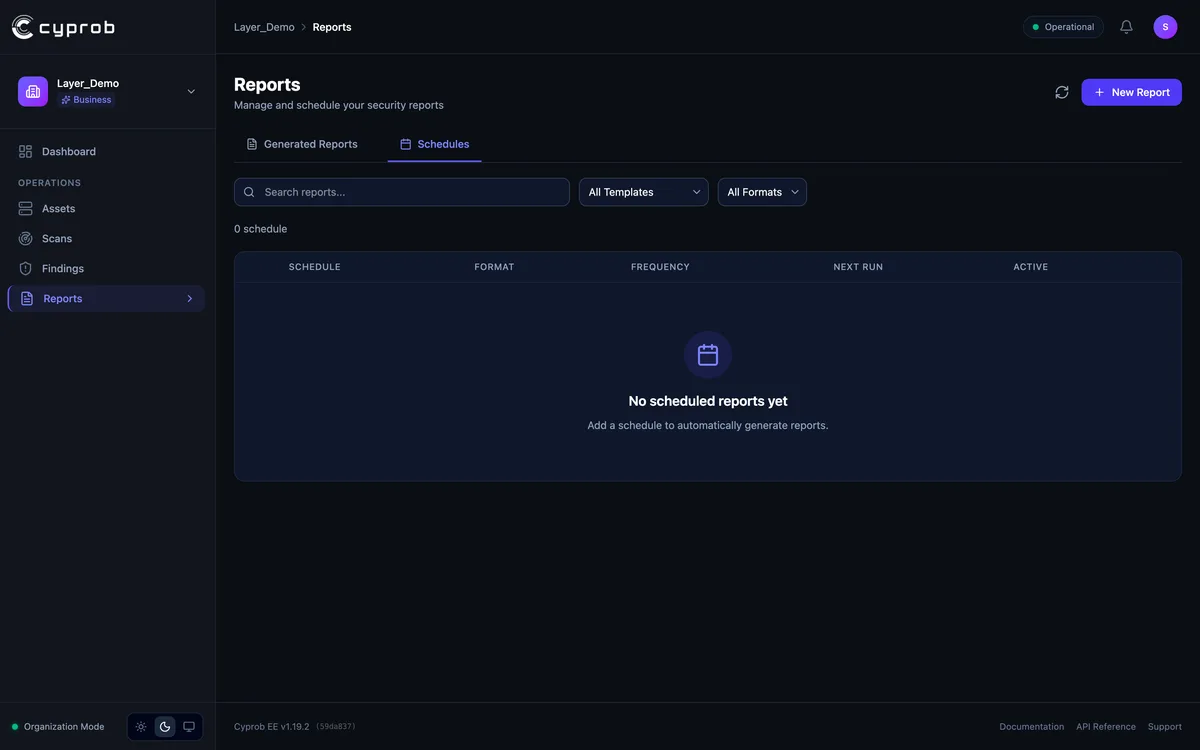
Vulnerability management in banking runs alongside periodic audits. Reports are scheduled against the audit calendar. Every finding is stored with the request that was sent and the response that came back, and every action taken on a finding is written down with the user and the time. What was found, what was done about it and who did it can all be answered from the record.
Data stays inside the bank
The vulnerability map of a financial network is information that should not leave the bank. Cyprob runs on your own servers, inside your own network. There is no cloud connection, no external telemetry and no copy held elsewhere. For banks working under the Saudi PDPL or the UAE data protection law, this means records that contain personal data are processed within the same borders as the systems they describe.
The rules belong to the bank
The weaknesses of an in-house banking application are in no vendor catalogue. Your security team writes its own check in YAML, tries it against a narrow scope first, then opens it to the whole network. The definition of a control is set by the institution and does not wait on a release from anyone else.
Common questions
Is a report ready when the audit comes?
Yes. Reports are scheduled against the audit calendar, so the output is waiting when the period closes. Every finding carries its request and response evidence.
Is every action on a finding recorded?
Yes. Status changes are logged with who and when. What was found, what was done and who did it can all be answered from the record.
Can we scan applications built in-house?
Yes. No shipped catalog knows your in-house applications, so your security team writes the check in YAML, tries it on a narrow set of assets and then opens it to the whole network.